
May 1 2023
What has come to be known as the Epictetus Dichotomy of Control is a naïve misinterpretation of the opening of Epictetus’s Enchiridion.
This is a short debunking of it.
This is the popular rendering of the opening of the Enchiridion, however this particular wording is unattributed. (Nobody knows who produced this, it is not Elizabeth Carter as frequently assumed).
Things in our control are opinion, pursuit, desire, aversion
And there we have the naïve interpretation known as the Dichotomy of Control:
As a corrective, this is AA Long’s 2018 translation from his book “How to Be Free”:
What is up to us is judgment, motivation, desire, aversion
To understand what this means we can leave one Greek term untranslated.
ἐφ’ ἡμῖν μέν ὑπόληψις, ὁρμή, ὄρεξις, ἔκκλισις
eph’hemin men hupolepsis, horme, orexis, ekklisis
What is eph’hemin is judgment, motivation desire, aversion
It is a question of how we translate eph’hemin, which means literally “ours“, as in belongs to us. If we take these as a set [judgment, motivation desire, aversion], then we can read Discourse 1.1 On what is and is not up to us:
- Generally speaking, you’ll find no faculty that has the ability to examine itself, and therefore none that has the ability to assess itself and see whether or not it’s acceptable:
- Which faculty, then, will give you this information? The one that examines both itself and everything else.
- And which is that? The faculty of reason, because it’s the only one we’ve been granted that considers both itself—what it is, what it’s capable of, what value it comes with—and all the other faculties…
- Fittingly, then, the only faculty the gods made up to us [eph’hemin] was the best of them all, the master faculty—that is, the right use of impressions—but they made none of the others up to us [eph’hemin].
- But what does Zeus say? .. I’ve given you a portion of myself, this faculty of inclination and disinclination, of desire and aversion, or, to generalize, the faculty of making use of impressions..
- Divulge your secrets.’ I refuse, because that’s something that’s up to me [eph’hemin] ‘I’ll clap you in irons.’ What are you talking about, man? Me? You’ll shackle my leg, but not even Zeus can conquer my will [prohairesis]
So, to sum that up:
- eph’hemin is the faculty of inclination, disinclination, desire and aversion
- eph’hemin is the faculty of making use of impressions
- eph’hemin is the rational faculty that can analyse itself
- eph’hemin is prohairesis, our ability to make rational choices.
- eph’hemin is the master, ruling faculty which cannot be controlled.
If we go back to the naïve interpretation and switch out eph’hemin for control we can see how we got this:
What we control is judgment, motivation desire, aversion
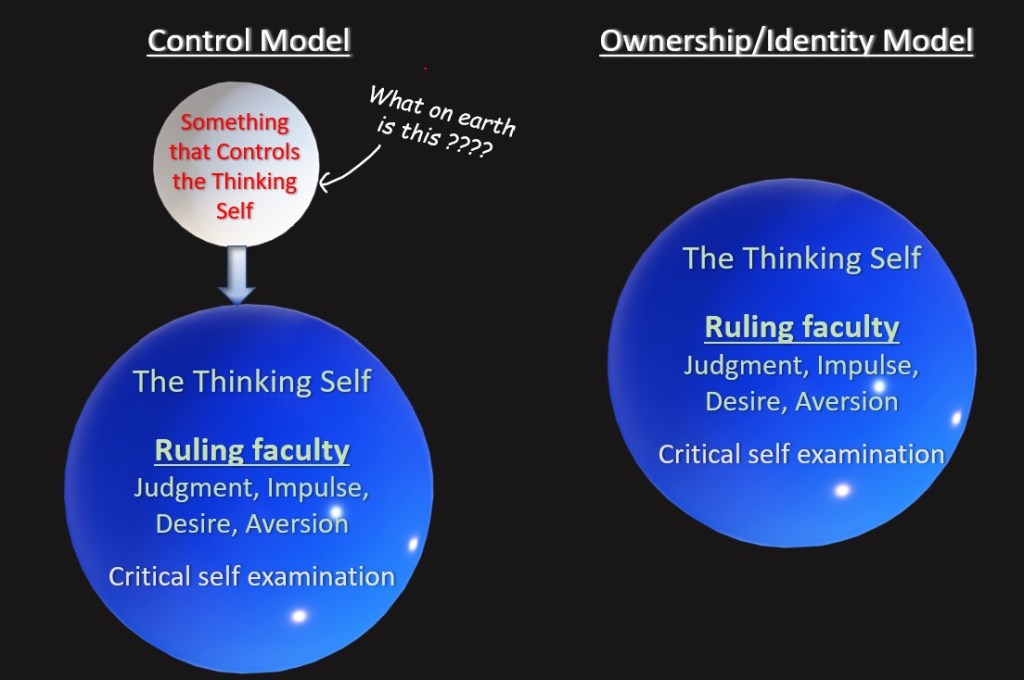
Having understood that [judgment, motivation desire, aversion] come as a set and knowing what as a set they correspond to: the control scenario means this.
We control our ruling faculty of reason that cannot be controlled
While what is controlled has nothing superior to it, it is being controlled while being that which is doing the controlling but, cannot be controlled, but it is being controlled and doing the controlling and so on ad infinitum.
So eph’hemin CANNOT mean control, which is no surprise because eph’hemin has never meant that in Greek.
If the ability to think rationality is at the top of the heap, what on earth is controlling it?
The answer is that nothing is controlling anything.
The answer is that rationality is examining itself.
Epictetus comes in again to explain.
Since it’s reason that analyzes and processes everything else, and since it shouldn’t go unanalyzed itself, what is it that analyzes it?
The answer, obviously, is that it is either reason itself or something else.
Now, this ‘something else’ must either be reason or something superior to reason, but there’s nothing superior to reason.
So, if it’s reason, the question again arises: what will analyze it?
If it’s a case of reason analyzing itself, the reason we started with can do that.
Otherwise, if once more we call on ‘something else’ to do the analyzing, we’ll find ourselves in an unresolvable, interminable regress:
Epictetus Discourse 1.17.
The only alternative and inescapable conclusion is eph’hemin means ours, and it does, quite literally.
What is ours is the ruling faculty of reason that can analyse itself and cannot be controlled
It is Socratic critical self examination: metacognition; the ability to reflect rationally upon our own thinking and judgments.
And here we have it stated explicitly and unequivocally.
Some things are ours and some are not. What is ours is prohairesis and everything that is the work of prohairesis
ὅτι τῶν ὄντων τὰ μέν ἐστιν ἐφ᾽ ἡμῖν, τὰ δὲ οὐκ ἐφ᾽ ἡμῖν ἐφ᾽ ἡμῖν μὲν προαίρεσις καὶ πάντα τὰ προαιρετικὰ ἔργα,
Discourse 1.22.10
Prohairesis is the rational faculty that can analyse itself and that which alone is ours.
 Living Stoicism
Leave a comment