
Living Stoicism

Socratic Philosophy for the 21st Century


In Defence of Stoic Physics

The four elements. :

The Greeks were familiar with snow, water, steam, and the role of fire, and they were well aware of the expansion and contraction due to heat. That knowledge is much older than the Stoics. They were further accomplished metallurgists, cooks, and farmers and had a grasp of meteorology.

The development of this line of thinking can be tracked back in history; Aristotle covers it in depth. It is not anachronistic retrospective wishful thinking.

The four elements are phase states, solid, liquid, gas, and plasma, different energy states of the unified substrate, varying in temperature, density and activity,

Using an example from Jula’s Wildeberger’s book Seneca und die Stoa , we can check these for similarity, coherence, correspondence, and predictable explanatory force.
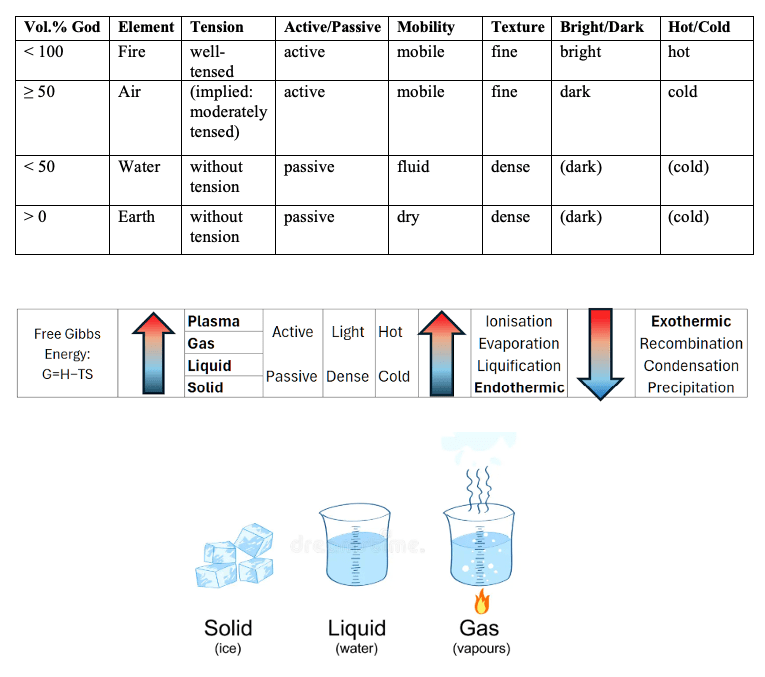
• Similarity: The elements or phase states share the same properties across models.
• Coherence: The relationships and transitions between these elements follow a consistent pattern.
• Correspondence: They closely map onto one another, demonstrating a strong relationship.
• Explanatory Force: The alignment of these models indicates a unified understanding of the physical world grounded in empirical observation, rational inference, and logical reasoning, with roots tracing back to philosophers like Aristotle and Empedocles.

Possible Conclusions

  1. There is clear similarity correspondence, coherence, and predictable explanatory connection between Stoic elements and phase states, so we can identify them as the same.
  2. There is a miraculous coincidence of impossible improbability.

We can acknowledge that modern science has precise mathematical/geometric models for these phenomena.

However, the conception of a physical theory is always prior to the formal mathematical/geometric expressions of that theory, and a conceptual theory can be found to be good in principle well after its original formulation. If there is a fit, it should not be denied without justification.

Dismissing the resemblance without explaining how or why this remarkable alignment exists or why it should be rejected as a mere insignificant coincidence would fly in the face of any good practice and ignore the documented history of natural philosophy and the evolution of scientific thought

The four elements. :

The Greeks were familiar with snow, water, steam, and the role of fire, and they were well aware of the expansion and contraction due to heat. That knowledge is much older than the Stoics. They were further accomplished metallurgists, cooks, and farmers and had a grasp of meteorology.

The development of this line of thinking can be tracked back in history; Aristotle covers it in depth. It is not anachronistic retrospective wishful thinking.

The four elements are phase states, solid, liquid, gas, and plasma, different energy states of the unified substrate, varying in temperature, density and activity,

Using an example from Jula’s Wildeberger’s book Seneca und die Stoa , we can check these for similarity, coherence, correspondence, and predictable explanatory force.

• Similarity: The elements or phase states share the same properties across models.
• Coherence: The relationships and transitions between these elements follow a consistent pattern.
• Correspondence: They closely map onto one another, demonstrating a strong relationship.
• Explanatory Force: The alignment of these models indicates a unified understanding of the physical world grounded in empirical observation, rational inference, and logical reasoning, with roots tracing back to philosophers like Aristotle and Empedocles.

Possible Conclusions

  1. There is clear similarity correspondence, coherence, and predictable explanatory connection between Stoic elements and phase states, so we can identify them as the same.
  2. There is a miraculous coincidence of impossible improbability.

We can acknowledge that modern science has precise mathematical/geometric models for these phenomena.

However, the conception of a physical theory is always prior to the formal mathematical/geometric expressions of that theory, and a conceptual theory can be found to be good in principle well after its original formulation. If there is a fit, it should not be denied without justification.

Dismissing the resemblance without explaining how or why this remarkable alignment exists or why it should be rejected as a mere insignificant coincidence would fly in the face of any good practice and ignore the documented history of natural philosophy and the evolution of scientific thought

Leave a comment