-
Some things are what? What does the beginning of the Enchiridion mean?
The Enchiridion of Epictetus is thought to be a basic introductory text to Stoicism. It is however a very advanced text, that needs a lot of context. This is an attempt at that. This is neither a paper nor an essay, but more like a class room exercise, encouraging a close reading the Stoics carefully,… Continue reading
-
In Defence of Stoic Physics
This post argues that the Greek “four elements” are not mystical substances but early descriptions of physical phase states: solid, liquid, gas, and plasma. The Greeks understood heating, cooling, expansion, contraction, and the behaviour of matter long before the Stoics, and this conceptual framework is traceable earlier natural philosophers. When the Stoic scheme is compared… Continue reading
-
James Daltrey on Stoicism, Determinism and Fate
by Keith P. Myers Many say that the Stoics were determinists, or at least compatibilists, which is simply a form of qualified determinism. But the problem with this is the fact that determinism requires abstract laws to operate. In the absence of that idea, it is not determinism. And the Stoics did not believe in… Continue reading
-
James Daltrey on Virtue & the use of Indifferents
By Keith Myers First of all, “indifferent” does not mean “indifference”. How can a sculptor learn to sculpt in the absence of marble? Externals are the stuff upon which virtue works. No externals, no virtue. Virtue is knowledge of the use of externals, and experience is important. You will never know how to drive a… Continue reading
-
Epictetus: Discourse 1.1: On What is Eph’Hemin.
There is eternal confusion over the meaning of the first chapter of the Enchiridion. What is missed is that that the Enchiridion is the Cliff Notes to a larger text, the Discourses of Epictetus compiled by his student Arrian. I have a fuller explanation of the discussion in this article:Some things are what? What does… Continue reading
-
Socrates don’t kno nuffink
This keeps cropping up in online debates: “The paraphrased saying, though widely attributed to Plato’s Socrates in both ancient and modern times, actually occurs nowhere in Plato’s works in precisely the form “I know I know nothing.” Wikipedia To give some context, Socrates that he is the wisest man in Athens by the Oracle at… Continue reading
-
Off the cuff comments on the discussion of Providence or Atoms in Marcus Aurelius
Some incomplete notes on the Discussion of Providence or Atoms in Marcus, put online for the purposes of a specific debate. It is a technical question. It is physics, how the world is made, of what. Providence is the substance of the universe, it is determinism itself, fixed causality itself, It is that all things… Continue reading
-
Stoic Cosmology and Ethics
The Stoics had a naturalistic ethics based on an understanding of behaviors that can be identified as appropriate to any animal, in the specific case of humans, as social creatures endowed with language and language based reason, we are innately equipped with the potential to identify what is beneficial in the world, and what is… Continue reading
-
The Scientific God of the Stoics

Originally featured on thesideview.com This article is published as an addition as an addition to issue 2 of The Side View Journal. The article continues an ongoing dialogue initiated by Brittany Polat, and continued by Kai Whiting and Massimo Pigliucci. In a recent article in The Side View, entitled “The Stoic God Is Untenable in the Light of Modern Science,” philosopher Massimo… Continue reading
-
What is Controlling What?
The Stoic Dichotomy of Control is a modern invention that fails to understand and completely distorts the actual message of Epictetus. Continue reading
-
The Enchiridion, Or Manual, Of Epictetus by Elizabeth Carter (1758)
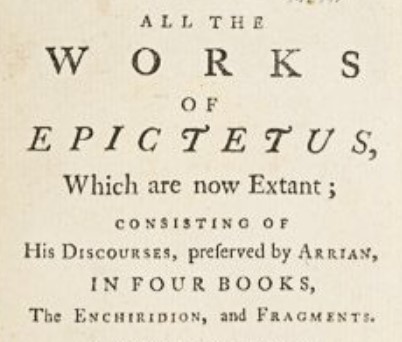
There is a very a popular version of Enchiridion on the internet attributed to Elizabeth Carter which is not authentic. This is her work. “Of things, some are in our power and others not” Continue reading

 Living Stoicism